


Using a hoist at home is often the point where a family realises that manual lifting alone isn’t safe for them or their loved one any longer. This takes the physical strain out of moving someone who can’t stand, transfer or weight-bear on their own, whether that’s getting from bed to chair or in and out of the bath.
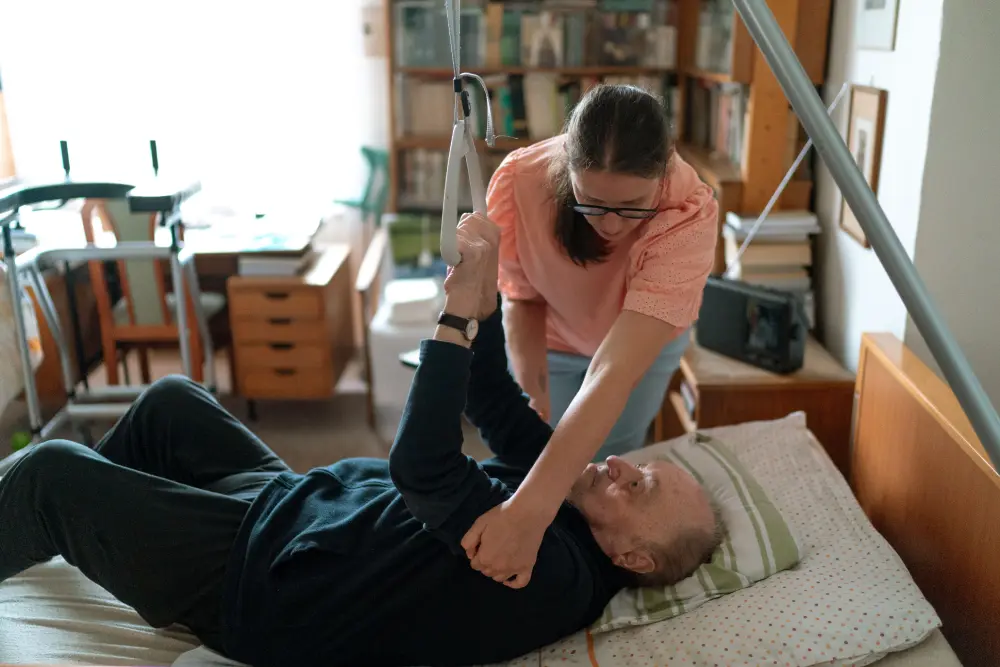
This guide explains the main types of hoists, how they’re introduced safely, and how home care can support your loved ones at a vulnerable time.
Table of Contents
- What is a hoist and when is one needed
- Types of hoists used at home
- How to get a hoist assessed and installed
- Safety rules families need to know
- Frequently asked questions
- Get support with hoisting and personal care
A short guide to using a hoist at home
|
What is a hoist and when is one needed
A hoist is a piece of lifting equipment that supports and moves a person who can’t safely stand, transfer or bear weight on their own, using a sling and a lifting mechanism. It’s typically introduced once manual lifting has become unsafe for either the person being cared for or the person providing that care.
This may be recommended if someone has lost significant mobility due to a stroke, a progressive condition, an injury or advanced frailty, and can no longer take part in a standing or standing-assisted transfer.
Rather than relying on family members or carers to physically lift, a hoist takes on the load mechanically, reducing the risk of injury to everyone involved and making transfers more comfortable and dignified for the person being moved.
Recognising the point where manual handling is no longer appropriate is important. Continuing to lift someone without the right equipment puts both the carer and the person they’re supporting at real risk of injury.
Types of hoists used at home
There are two main types of hoists used in home settings, and the right choice depends on the layout of the home, how often the hoist will be used, and the level of support the person needs.
Mobile hoists sit on a wheeled base and can be moved from room to room, which makes them flexible for households where hoisting happens in more than one location, such as the bedroom and bathroom. They use a sling to support the person, hooked onto the hoist’s arm, and are operated with hand controls or a pendant.
Ceiling track hoists, on the other hand, run along a fixed track installed in the ceiling instead, moving the person along a set route between key points, such as from the bed to a chair or into an en-suite bathroom. They take up less floor space, but need the track professionally fitted and are less flexible if care needs change and different rooms come into use.
A third option, standing hoists, suits people who can still bear a little weight through their legs and just need support to stand and pivot, rather than being lifted fully off the ground.
“A hoist can feel intimidating the first few times, even once the training’s been given. Having someone experienced there, who’s done it hundreds of times, tends to settle everyone down, the person being moved as much as the family. It’s less about the equipment and more about the confidence that comes with getting used to it properly.” – Tracey Harris, Head of Care |

How to get a hoist assessed and installed
A hoist isn’t something families should choose and buy without professional input, since the wrong type or a poorly fitted sling can be unsafe. The process usually starts with an occupational therapy assessment, arranged through a GP referral or directly with the local council’s adult social care team.
During the assessment, an occupational therapist looks at the person’s mobility needs, their weight, the layout of the home, and where hoisting will typically happen, before recommending the most suitable type of hoist and sling.
In some cases, equipment is provided on loan by the council rather than needing to be bought privately.
A ceiling track hoist will usually need a separate installation visit too, since the track has to be fitted securely into the ceiling structure. It’s worth starting this process before a hoist becomes urgently necessary, as assessments and installations can take time.
Safety rules families need to know
Under the Lifting Operations and Lifting Equipment Regulations 1998 (LOLER), lifting equipment used to move people, including hoists and slings, must be thoroughly examined at suitable intervals by a competent person, according to the Health and Safety Executive (HSE). For equipment used to lift people, this examination is required at least every six months.
Families using a hoist privately at home should still follow this guidance closely, checking the hoist and sling before each use for any visible damage, fraying or wear, and keeping the equipment within its stated weight limit.
The sling matters as much as the hoist itself. Using the wrong size or type of sling for the person and the task can lead to discomfort or a genuine risk of someone slipping, so slings shouldn’t be swapped between people or tasks without checking they’re suitable.
Frequently asked questions
Can a family member use a hoist without professional training?
Family members can be shown how to safely use a specific hoist by an occupational therapist or equipment provider during assessment and handover, and shouldn’t attempt hoisting without this guidance. Proper instruction matters as much as the equipment itself.
How often does a hoist need to be checked or serviced?
Lifting equipment used to move people must be thoroughly examined at least every six months under LOLER, in addition to a visual check before each use for damage or wear.
Servicing intervals may be shorter depending on the manufacturer’s guidance and how frequently the hoist is used.
Is a hoist covered by the NHS or council, or does it need to be bought privately?
Some hoists and slings are provided on loan following an occupational therapy assessment through the local council, though this depends on eligibility and local resources.
Families who don’t want to wait for an assessment can also buy or hire equipment privately, ideally with professional advice on the right type.
What’s the difference between a mobile hoist and a ceiling track hoist?
A mobile hoist sits on a wheeled base and can be moved between rooms, offering flexibility if hoisting happens in more than one part of the home. A ceiling track hoist is fixed and moves along a set route, taking up less floor space but requiring professional installation and being less adaptable if care needs change.
Does needing a hoist mean someone can no longer live at home?
No, many people continue to live at home safely and comfortably once a hoist and the right support are in place.
Get support with hoisting and personal care
Introducing a hoist is a big change for any family, and it’s natural to feel unsure at first, even once the training’s been given.
Forest Homecare’s care workers are trained in safe moving and handling, including hoist and sling use, and can support your loved one’s transfers as part of a wider care plan. Get in touch for a free Care Needs Assessment and we’ll talk through what support would help most.